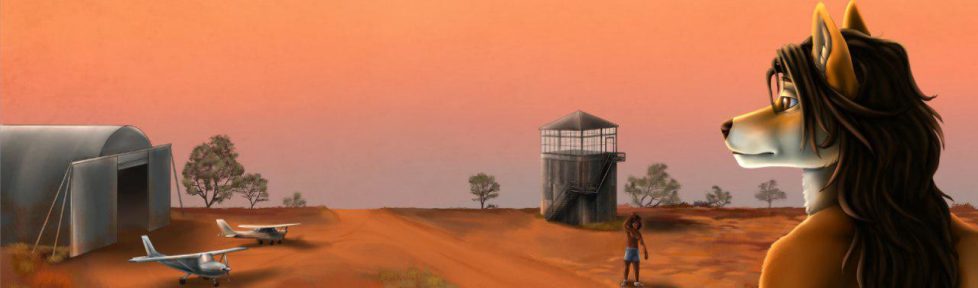
Terrified and on the run, Clarence Lowe flees his privileged life for Konalepti Spaceport. Rather than a clean getaway, he finds himself naked, abandoned, and friendless in Anthro-Town, the city’s destitute underground, among its population of inscrutable and suspicious animal-men. But rather than a wretched slum filled with desperate, struggling creatures, he finds a thriving and distinct culture built upon the rubble and refuse of his own. Clarence struggles to adapt to this new society, while staying one step ahead of his past.
This story runs as a three-parter, and had an interesting twist in its writing. In the middle of writing it, I went off to do something else for a while, and when I got back to it, I realized I couldn’t remember the ending I’d had in mind. This tasked me with basically having to solve a mystery I’d written. I don’t think there was ever a moment when the light dawned and I thought, “Ah, yes, that’s what I was going to write.” So I ended up writing the ending I was most likely to write.
Werewolf pelts go for up to ten thousand dollars a pop, so werewolf hunting, though illegal, is lucrative. And if a human kills a werewolf, there’s no guarantee that the Pack will get any justice. But werewolves can’t kill humans, so their own justice won’t fit, either. The answer is to forcibly transform the human into a werewolf. As a werewolf, the killer must respect the orders of the beast that created him. As a killer, the werewolf is immediately exiled from the Pack’s grounds. So the killer is trapped in a body he despises and bound to never harm another werewolf. Many hunters subjected to this treatment don’t survive. Unable to live among humans or werewolves, some hunters choose the easy way out. But some eventually learn to live with themselves.
Albert is captured in Carver Gore hunting one of their most beloved and accomplished members, and is easily run down and transformed by Gabriel’s friends. Now he’s lost in the woods and taunted by a tween pup with a smart phone and a smart mouth, his only guide in this bizarre new world, and unable to return to his own. As Duncan leads him to his inevitable exile, Albert starts to suspect that something else is going on – something worse than being stuffed into the wrong body.
Two films were released a week apart in late December 1997: “An American Werewolf in Paris” and “Titanic.” Since I was interested in both films, it gave me the opportunity for my own little Barbenheimer, and the result was this story.
For a while, I ran a website called “The Half-Million” that served much the same function as the Patreon – a repository for stories that had nowhere else to go. “An American Werewolf on the Titanic” was one of those stories. It lived there for a couple of years, until I dismantled the site in favor of actually trying to get stuff published.
Last year, while doing an extensive audit on nearly forty years of writing, I found the Half-Million on an old hard drive, complete and intact. With the Patreon up and running and begging for new material, the Half-Million was a potential treasure trove of content – if the 25-year-old stories were any good. Somehow, I got the giggles when I read the title “An American Werewolf on the Titanic,” and just had to give it a look.
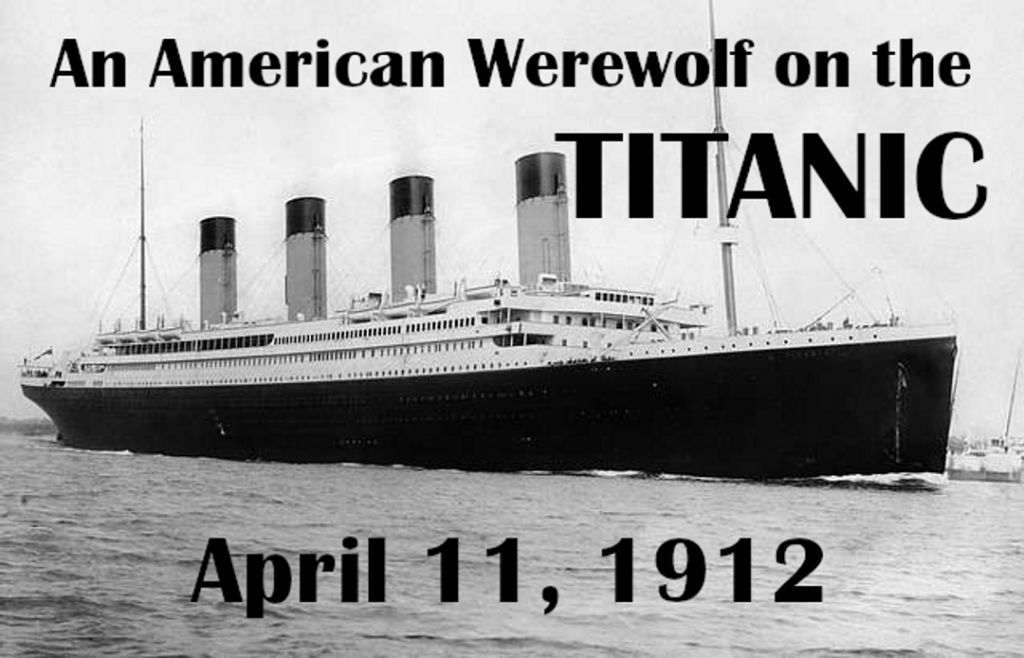
The story was pretty much exactly what it says on the tin – a wealthy werewolf (an ancestor of Benedict Kindernacht, protagonist of the Amanda K stories) travels first-class on the Titanic with his assistant and partner Walter Moskowitz. Ship hits iceberg, and Kindernacht, unwilling to let his partner freeze in the cold waters of the Atlantic, transforms him as the ship goes down, the better that they might survive the tragedy. It didn’t have much to say about class and culture and having our passengers ride first-class seemed a way to avoid certain inconveniences, nothing more.
Clearly, the story was due for a rewrite.
Over the next several weeks, I wrote feverishly on an aging laptop with 26 open browser tabs and a ream of research, trying to create a Titanic that wasn’t a borrowed vision from a 1990s filmmaker. Since the movie, everyone’s an expert, so I knew I’d get letters if I had so much as a bolt out of place. I had blueprints and layouts, pictures and portraits, costumes and props. And I made the ship itself problematic to its two illicit passengers; to Miles, a symbol of the conquest of nature; to Walter, a symbol of the structures that destroyed his life. A story that begins as pastiche ends the only way a story about the Titanic can end.
The story is one of the longer ones I’ve posted to Patreon, the longest story at the $3 tier, and free-to-read until March 26. It all begins here, April 11, 1912 – with the ship in Cobh Harbor and two crates that do not contain marble statues.
The three-part “Thou Shalt Not…” comes to an end, dependent on whether Harris Baker can let go of his vendetta. Astute readers might notice that the timeframe is a bit compressed; the events of the story really wouldn’t happen that quickly, but Baker’s bad decisions seem to hustle things along. Meanwhile, Simon is well on his way to discovering who he really is, and finding a family strong enough for him.
“The Way I Lived, Out Here With You” is this week’s free story, about a werewolf struggling to end a difficult period of mourning for the sake of a loved one. How do you move on without feeling like you’re abandoning those you’ve lost?
One of the things I found interesting in my re-read of this older story is that nothing Harris does inconveniences the Tribe in the slightest. Konac Namaroc isn’t part of the legal team defending his property, so this existential battle is going on entirely in the background. His people just live their lives as Harris throws money at the lawsuit.
But Harris was right about one thing. It isn’t safe for Simon among the Namaroc, and he will get hurt. Not through any fault of the Tribe, and not in the way anyone expects, but there are dangers the Pack hasn’t found – dangers that eventually find Simon.
“Thou Shalt Not…” was one of two stories I wrote for an anthology.
The story was supposed to center on Harris Baker’s obsession and jealousy with his neighbors, and how that obsession cost him everything. Instead, Simon’s gentler coming-of-age story turned out to be a much more pleasant place to be. The result is reflected in the story, with Harris’s scenes curt, abrupt, and hurried, while Simon’s scenes are lavish and detailed. Which would you rather do – spend an idle summer swimming in secluded rivers, or trying to steal your neighbor’s house?
It’s interesting to rub these two stories together and see how werewolves have evolved over thirty years; “Solitary Company” would have been written in the early 1990s, while “Wanderers in the Dark” was written just a few years ago. Banning Deerblood is a heavyset, leather-wearing biker who owns a dive bar on a decrepit back road; Garrebor and Tarrock are ascetic scouts for a secluded tribe of New England werewolves. Banning is shy and timid, keeping his dual nature under his hat for discretion, while Garrebor and Tarrock are loud and fulsome about their circumstances.
But the one that caught my eye is that Banning Deerblood can shapeshift, and Garrebor and Tarrock cannot.
The elimination of shapeshifting was an odd turn for my writing to take. It’s pretty much what werewolves are famous for. In fact, a lot of my characters would have a much easier time of it if they could shapeshift. But in my current work, becoming a werewolf involves finding a Pack that will have you, and undergoing a grueling initiation and painful transformation. Nobody gets randomly bit during a hike in the gloaming. And the transformation is one-way. There’s no going back.
 The Wolf Writer: Ben Goodridge dot com