Terrified and on the run, Clarence Lowe flees his privileged life for Konalepti Spaceport. Rather than a clean getaway, he finds himself naked, abandoned, and friendless in Anthro-Town, the city’s destitute underground, among its population of inscrutable and suspicious animal-men. But rather than a wretched slum filled with desperate, struggling creatures, he finds a thriving and distinct culture built upon the rubble and refuse of his own. Clarence struggles to adapt to this new society, while staying one step ahead of his past.
This story runs as a three-parter, and had an interesting twist in its writing. In the middle of writing it, I went off to do something else for a while, and when I got back to it, I realized I couldn’t remember the ending I’d had in mind. This tasked me with basically having to solve a mystery I’d written. I don’t think there was ever a moment when the light dawned and I thought, “Ah, yes, that’s what I was going to write.” So I ended up writing the ending I was most likely to write.
Werewolf pelts go for up to ten thousand dollars a pop, so werewolf hunting, though illegal, is lucrative. And if a human kills a werewolf, there’s no guarantee that the Pack will get any justice. But werewolves can’t kill humans, so their own justice won’t fit, either. The answer is to forcibly transform the human into a werewolf. As a werewolf, the killer must respect the orders of the beast that created him. As a killer, the werewolf is immediately exiled from the Pack’s grounds. So the killer is trapped in a body he despises and bound to never harm another werewolf. Many hunters subjected to this treatment don’t survive. Unable to live among humans or werewolves, some hunters choose the easy way out. But some eventually learn to live with themselves.
Albert is captured in Carver Gore hunting one of their most beloved and accomplished members, and is easily run down and transformed by Gabriel’s friends. Now he’s lost in the woods and taunted by a tween pup with a smart phone and a smart mouth, his only guide in this bizarre new world, and unable to return to his own. As Duncan leads him to his inevitable exile, Albert starts to suspect that something else is going on – something worse than being stuffed into the wrong body.
Elliot wakes up, drugged and badly wounded, in a plywood room next to the body of his human girlfriend, his fur soaked with her blood. A devilish voice mocks and taunts him from the shadows. For a moment, he’s balanced on the blade of despair.
But werewolves are survivors, and Elliot is stronger than he thinks. Instead of falling into madness, he decides to peel back the artifice behind his gruesome situation and uncover what his memory has lost. As his strength returns by degrees, so does his determination – and a cruel game master will discover how little he knows about Elliot’s people.
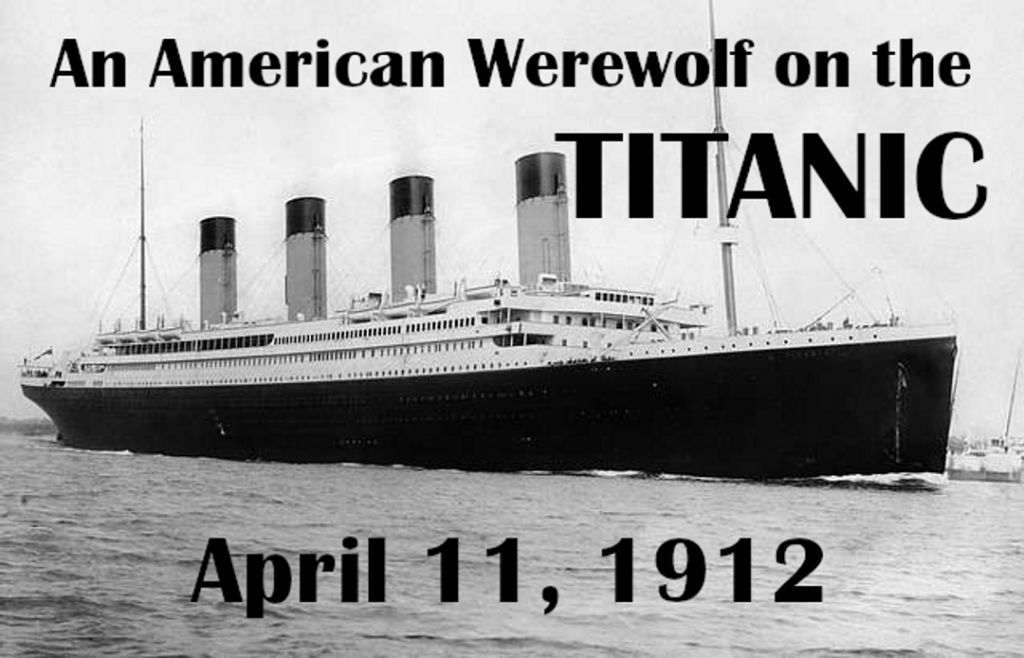
Two films were released a week apart in late December 1997: “An American Werewolf in Paris” and “Titanic.” Since I was interested in both films, it gave me the opportunity for my own little Barbenheimer, and the result was this story.
For a while, I ran a website called “The Half-Million” that served much the same function as the Patreon – a repository for stories that had nowhere else to go. “An American Werewolf on the Titanic” was one of those stories. It lived there for a couple of years, until I dismantled the site in favor of actually trying to get stuff published.
Last year, while doing an extensive audit on nearly forty years of writing, I found the Half-Million on an old hard drive, complete and intact. With the Patreon up and running and begging for new material, the Half-Million was a potential treasure trove of content – if the 25-year-old stories were any good. Somehow, I got the giggles when I read the title “An American Werewolf on the Titanic,” and just had to give it a look.
The story was pretty much exactly what it says on the tin – a wealthy werewolf (an ancestor of Benedict Kindernacht, protagonist of the Amanda K stories) travels first-class on the Titanic with his assistant and partner Walter Moskowitz. Ship hits iceberg, and Kindernacht, unwilling to let his partner freeze in the cold waters of the Atlantic, transforms him as the ship goes down, the better that they might survive the tragedy. It didn’t have much to say about class and culture and having our passengers ride first-class seemed a way to avoid certain inconveniences, nothing more.
Clearly, the story was due for a rewrite.
Over the next several weeks, I wrote feverishly on an aging laptop with 26 open browser tabs and a ream of research, trying to create a Titanic that wasn’t a borrowed vision from a 1990s filmmaker. Since the movie, everyone’s an expert, so I knew I’d get letters if I had so much as a bolt out of place. I had blueprints and layouts, pictures and portraits, costumes and props. And I made the ship itself problematic to its two illicit passengers; to Miles, a symbol of the conquest of nature; to Walter, a symbol of the structures that destroyed his life. A story that begins as pastiche ends the only way a story about the Titanic can end.
The story is one of the longer ones I’ve posted to Patreon, the longest story at the $3 tier, and free-to-read until March 26. It all begins here, April 11, 1912 – with the ship in Cobh Harbor and two crates that do not contain marble statues.
I wrote “Hot” in the dead of winter, coldest day of the year, with the wind howling outside the windows and the thermometer reading 8F. I was thinking about how my earlier complaining about the snow and cold would soon give way to complaining about the suffocating summer heat, giving the impression that one could never be truly satisfied with the weather.
The story went a long way toward cementing the Tribe as a running series; after writing it, I edited older stories to match its setting. The town of Ashton, Maine, a former mill village with a population of around 9,600, puts in its first appearance, 24 miles from Carver Cabin in Carver Gore, the territory of the Tribe and the 152 werewolves who call its dozen or so square miles of unincorporated land their home. The Tribe’s leader, called simply “The Master,” is a young visionary celebrated throughout the Pack for his problem-solving skills, though the people remain largely ungoverned. The Pack’s freedom is partly due to the legal maneuvering of Gabriel Blaine, a member of the Pack who passed the bar and created a non-profit trust granting the Pack stewardship of Carver Gore.
The werewolves of the Tribe are an indolent, goofy lot, though they do have the ability to lock-in when one of their own is in danger, and they have little tolerance for hostile humans. “Hot” asks a lot of its two protagonists: what do you do next when you’ve achieved your greatest dream? When does ennui turn into depression? How do you encourage someone else to take the reins of your life? And is the problem really just the heat, or is it something deeper? As Breakwater and Patrick stumble out of the woods on their fool’s quest to briefly join civilization, they’re confronted by their neglect of a part of themselves as beautiful as any beast.
I feel like I want to come back to this world at some point. Two mighty tribes have been at war so long that there hasn’t been a battle in centuries, and their conflict has evolved into a rigid slate of rules and courtesies designed to prevent violence from flaring up and involving both tribes. Two fierce warriors of these opposing tribes meet in the ruins of an ancient city, and cautiously dance around each other, trading insults and shaking weapons to cement their antagonism. Waltz of the frenemies.
Torvik continues to struggle with growing up; he thinks it’s a stupid idea and doesn’t want to do it, not that he has a choice. His body has been making some bad decisions for him lately, and he’s feeling churlish and short. His easygoing Kahjah opponent pities him somewhat, which outrages him further, and he’s picked a fight he hasn’t a prayer of winning…
“Say, whatever happened to Chancellor Damon and Emperor Kellin after the Battle of the Caldera in ‘Found: One Apocalypse?'” said literally no one. But the original plot to the story that became this behemoth series was the entire Galaxy and all its various factions targeting the broken-down battleship for their own purposes, so it was time to wheel in another faction.
They’re pronounced “ZAY-tuss,” and that’s singular and plural. I suppose they’re a response to all the honor-before-reason barbarian species cooked up to keep science fiction moving. They look like seven-foot-tall anthropomorphic dragons, and they have a little gland at the base of their skulls that creates a hormone that makes them brutally competitive. Put two Zatus in a room together and they’ll beat each other up as soon as they get bored.
It doesn’t take long for Damon to realize that this civilization of death-before-dishonor barbarian lords is all hat and no cattle, and that when your civilization is death-before-dishonor, you end up generating a society of rules lawyers and backstabbers. Everyone aboard the Silver Star has great talent and abilities, none of which are valued by a society of skull-thumpers. So Damon is left to navigate this culture as best as he can. At least they’re honest with him.
I was going over this story for about the third time before posting it to Patreon when a random neuron fired and I suddenly remembered a story I first read in high school called “By the Waters of Babylon,” by Stephen Vincent Benet. Suddenly, scenes from it sprang fully-formed in my mind, images I haven’t thought of in nearly forty years.
I’ve written a lot of post-apocalyptic fiction that uses an urban environment being crushed by encroaching nature, and in the abstract, “Path of the Hunters” is just another in the conga line. None of it was written with “By the Waters of Babylon” in mind, at least not consciously, but this story probably falls closest to it on the scale.
Werewolves can’t kill humans. That’s not to say it doesn’t happen once in a while, usually by accident or in self-defense, but it does open an interesting question: what to do when a human hunts a werewolf.
Werewolf pelts are a much-sought symbol of masculinity among certain groups of people. Pretty sure Matt Walsh has one up on his wall in this world. It’s illegal, but the law is inconsistent on the subject and inconsistently enforced. And werewolves can’t kill humans – so, unwilling to turn a murderous human over to the authorities, and unable to punish them appropriately themselves, what does a werewolf do with a werewolf-hunter?
“In the Cave” was written as a college assignment in the early 1990s. To be honest (rub back of neck, nervous glance about the room) I didn’t get much out of college writing classes. I never received anything but the most ebullient praise in them, which is nice, but one doesn’t learn much from it. I would have been better served with lessons in an absorbing opening, rising action, building suspense, characterization, and a memorable climax. Instead, it was a circle of a dozen students reading their prose and clapping each other on the back for their genius. The professor might as well have gone out for coffee.
Later, I rewrote “In the Cave” into “Cave of the Bear Clan.” There’s not much resemblance between the two stories, and I bet you can guess which one has bear-people in it. They’re both about troubled college students exploring a cave and discovering how the past and present can redeem each other.
I don’t know much about spelunking myself, as I’ve seen enough YouTube videos to horrify me out of ever visiting any cave that doesn’t have a tour guide and a gift shop. (Seriously, what are you people doing?) So the caves in these stories are big and roomy and atmospheric instead of the tight little cracks in the rock that seem to attract every claustrophile with a selfie stick looking for a granite hug. Honesty, props to the mission, but it’s not for me.



 The Wolf Writer: Ben Goodridge dot com